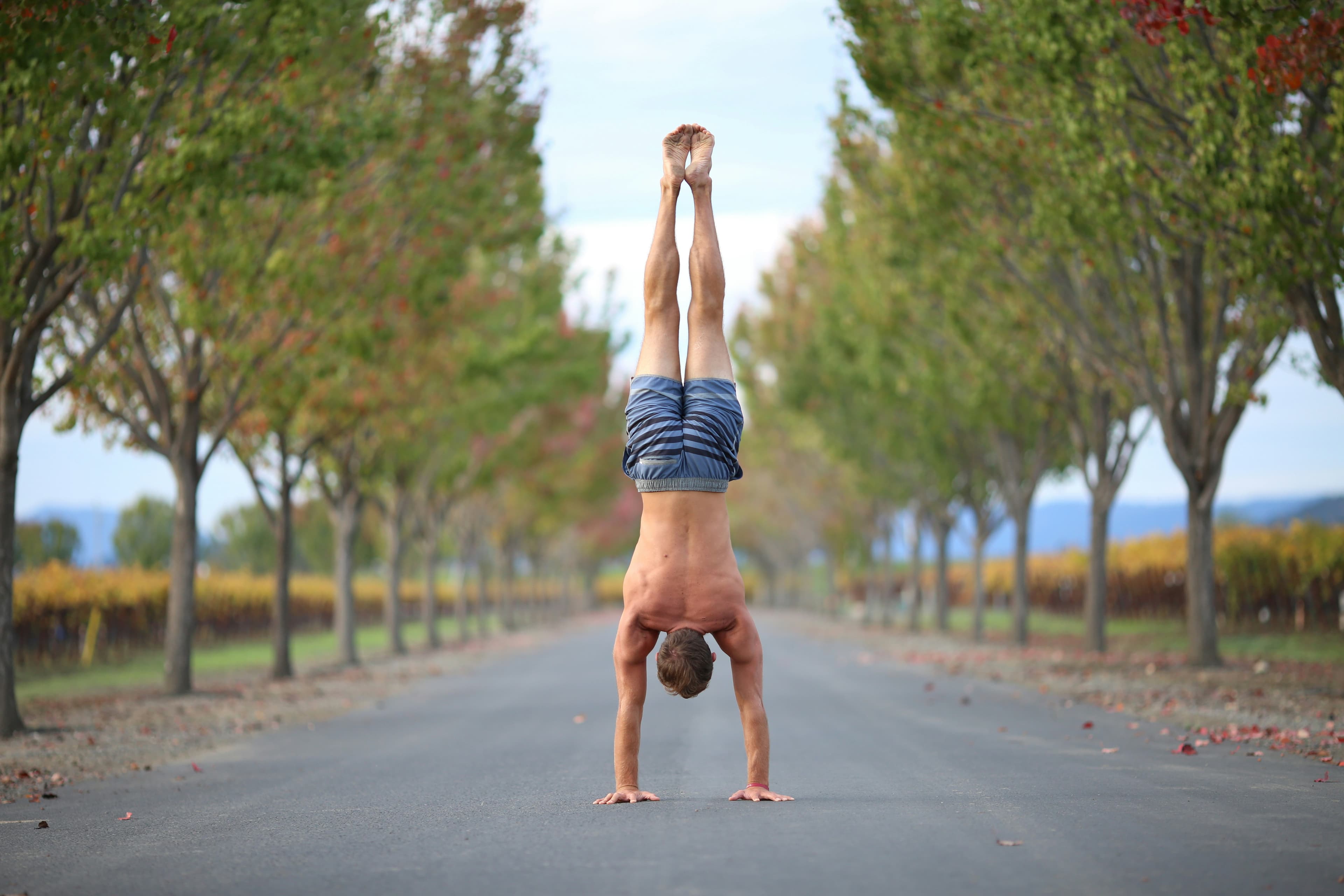
How to Learn a Handstand: The Step-by-Step Progression That Actually Works
Watch someone hold a handstand and it looks effortless — just a person, upside down, perfectly still. Then you try it for the first time and understand, very quickly, that nothing about it is effortless.
Most beginners kick up, panic, and crash within a second. They repeat this for weeks. Some give up. Others grind through months of wall training only to discover they still can't stand freestanding without the wall. It feels like the skill is impossible, or at least reserved for gymnasts and circus performers.
It isn't. But learning a handstand the right way requires a shift in how you think about it.
A handstand is a skill, not a strength exercise. That one reframe changes everything — how often you train, how you measure progress, why some days feel like regression, and what "getting better" actually looks like. Treat it like a strength exercise and you'll plateau fast. Treat it like a skill and the path becomes clear.
This guide gives you that path, with honest timelines, real answers to the questions beginners are actually asking, and — because it's almost never described — what learning a handstand actually feels like from the inside.
What Kind of Skill Is a Handstand, Really?
Before touching a wall, it helps to understand what you're signing up for neurologically.
Motor learning science identifies three stages every new skill passes through:
- Cognitive stage — You're consciously thinking through every part of the movement. It feels awkward and deliberate. You can't do two things at once.
- Associative stage — The pattern is starting to form. You're refining, not figuring out. Progress feels real but inconsistent.
- Autonomous stage — The movement happens without active thought. You can focus on balance rather than mechanics.
Most handstand learners spend the majority of their time in the associative stage. You're no longer completely lost, but you're not there yet. Days where you can't hold two seconds are not signs of failure — they're how neurological skill learning works. Sleep, stress, fatigue, and focus affect balance far more than they affect strength. A bad handstand day means nothing about whether you're improving.
How Long Will It Actually Take?
Here's the honest answer, which most guides avoid:
| Background | Time to Reliable Freestanding Hold |
|---|---|
| Gymnastics or yoga background | 1–3 months |
| General fitness, no gymnastics | 3–6 months for a 10-second hold |
| Complete beginner, low baseline fitness | 6–12+ months |
These are coaching estimates, not clinical data — there aren't controlled trials on handstand timelines. But they're consistent across experienced coaches and match what the broader training community reports. Working with a coach or following a structured program can cut the timeline roughly in half compared to unguided solo practice.
One thing the range doesn't capture: the goal matters. A 5-second freestanding hold is achievable for most people within a few months of focused training. A clean, 30-second, straight-body hold takes considerably longer.
Why Short Daily Sessions Beat Long Weekly Ones
Motor skill research consistently shows that distributed practice — multiple shorter sessions spread over time — produces better skill acquisition than massed practice — fewer, longer sessions. The skill consolidates during rest, not during the training itself.
In practice: 15 minutes of handstand work five days a week will outperform a 75-minute session once a week, even though the total volume is identical. This is especially important in the early stages when you're still in the cognitive and early associative phases.
Prerequisites: What You Need Before You Start
You don't need to be flexible, athletic, or young. You do need a few things.
Minimum Strength Requirements
- Plank hold: 30–45 seconds
- Pike push-ups: 5–8 reps
- Hollow body hold: 20–30 seconds
If you can hit these, you have enough strength to begin. The handstand will build more.
Mobility Check
Shoulders (most important): Stand against a wall and raise both arms overhead, keeping your lower back flat against the wall. If your ribs flare out or your lower back arches away from the wall before your arms reach vertical, your shoulder mobility needs work before you start handstand training. Tight shoulders don't just make handstands harder — handstand training with inadequate shoulder mobility can make tightness worse.
Wrists: Place your palm flat on the floor with your arm straight. Can you get the wrist to 90 degrees of extension without pain? If this is painful or very limited, spend a few weeks on wrist mobility work before loading it.
If your shoulders are the issue — common for anyone who sits at a desk — spend two to four weeks on shoulder opening work (banded overhead stretches, wall slides, thoracic extension) before starting the progression below.
A Note on Body Weight
Heavier beginners are not excluded from learning handstands, but they face higher absolute loads through the wrists and shoulders. This means progressing through wrist conditioning more gradually — not shorter sessions, just a longer adaptation period. Wrist conditioning is non-negotiable regardless of body weight; it just matters more.
Wrist Prep: The Non-Negotiable Warm-Up
A 2025 peer-reviewed cross-sectional study found that 56.7% of adult handstand practitioners report chronic wrist pain. That's the majority of people who do this regularly. Wrist pain is the single most common reason beginners cut sessions short or quit entirely.
Here's the thing most guides get wrong: wrist pain is a conditioning issue, not an equipment issue. Practicing on a soft surface (yoga mat, grass) doesn't help and can make it worse — softer surfaces force the wrist into a deeper extension angle, increasing stress on the joint. The floor is fine.
Do this five-minute sequence before every session, without exception:
1. Wrist circles — 10 rotations forward, 10 backward, both wrists. Slow and deliberate, not rushed.
2. Loaded wrist stretch — Place both hands flat on the floor, arms straight, and lean slowly forward over your hands. Hold 20–30 seconds. This stretches the wrist flexors under load — closer to what you'll ask of them in training.
3. Prayer / reverse prayer stretch — Press palms together in front of your chest (prayer position), then flip them to reverse prayer (backs of hands together, fingers pointing down). Hold each for 20–30 seconds.
4. Finger extension — Spread fingers wide, then gently press each hand back with the other. 10–15 seconds each.
5. Bear crawls — 20–30 feet of slow bear crawls (hands and feet, knees hovering just above the floor). This is the warm-up for the warm-up — it introduces wrist weight-bearing at low intensity before you invert.
Soreness vs. Injury: Know the Difference
| Type | What It Feels Like | What to Do |
|---|---|---|
| Normal adaptation | General ache/fatigue, fades within 24 hours | Continue training, keep volume modest |
| Warning sign | Pain that worsens during a session | Stop the session, rest, reduce volume |
| Injury | Sharp pain, pain with passive movement the next day, swelling | Rest; see a physio if it persists more than a few days |
Wrists typically take 4–8 weeks of consistent training before they stop being a limiting factor. This is normal. Don't skip the warm-up trying to shorten that window — it doesn't work.
Step 1: Get Comfortable Upside Down
Most handstand guides jump straight to wall training. That's a mistake for a lot of beginners, because the first real barrier isn't strength or technique — it's psychology.
Being inverted is neurologically unfamiliar. Your vestibular system — the part of your brain responsible for orientation in space — fires a low-grade alarm response when you're upside down for the first time. This is why people freeze when they kick up alone but can hold longer with a spotter: the spotter suppresses the alarm, not the body's inability to hold the position.
The good news: this response diminishes with repeated exposure. Research on vestibular adaptation shows that when an inverted position is repeated without a loss of balance, the stress response is inhibited over time. Your brain builds a new "safe position" map that includes upside down. This is a trainable thing — but you have to expose yourself to it repeatedly to get there.
Fear Conditioning Drills (Do These Before Any Kick-Up Attempt)
Downward dog hold: Hold downward dog for 30–60 seconds. Walk your hands closer to your feet to increase the inversion angle. This is partial inversion — enough to begin the vestibular adaptation process without any fall risk.
Pike walk-up on wall: Stand facing away from a wall, bend down, and walk your feet up the wall while your hands walk toward it. Get to hip height and hold for 20–30 seconds. This introduces the upside-down sensation in a controlled, slow way.
Headstand practice: The headstand is underused as a handstand prerequisite. It builds body awareness, inversion tolerance, and core engagement in a position where the consequences of falling are minimal. It also teaches you what "balance over your hands" feels like before you're at full inversion height.
Fall practice: Learn how to get out before you learn how to stay in. Practice the pirouette exit — as you feel yourself tipping forward, rotate 90° and step out into a side lunge — on a mat or grass, from standing, before you ever kick up. Do it 10–15 times until it feels natural. Knowing you can exit removes a significant part of the fear.
The Blood Rush
If you're new to inversions, you'll feel significant pressure in your head, eyes, and sinuses. This is normal and not dangerous in healthy individuals. It's caused by the change in blood pressure from gravitational redistribution — your cardiovascular system hasn't learned to compensate for the position yet.
Most people find this diminishes noticeably within two to four weeks of regular inversion practice. It doesn't disappear immediately, but it stops being a reason to cut sessions short. If you're finding it unbearable, limit holds to 15–20 seconds and build up. Don't push through dizziness — that's different from pressure.
Goal for this step: Be upside down in some form every day for one to two weeks before attempting kick-ups. That's it.
Step 2: Wall Handstand — Back-to-Wall
With wrists prepped and the fear conditioning underway, it's time to get upside down properly. The wall removes the balance problem entirely, letting you focus on building strength, learning alignment, and extending time inverted.
Back-to-Wall vs. Chest-to-Wall: The Debate Settled
You'll see coaches and forum posters argue both sides. Here's the full picture:
Back-to-wall is where you start. It's easier to enter (the kick-up is intuitive), you can load more weight to build shoulder and core strength faster, and you can hold longer. The downside is that it allows — and somewhat encourages — an arched lower back. This isn't a disaster; it's just why you don't stay here forever.
Chest-to-wall comes next. It forces a hollow body position because the arch is no longer available as a crutch. It's harder to enter and harder to hold, but the body position is much closer to what a freestanding handstand actually looks like.
Use both. Start with back-to-wall. Progress to chest-to-wall when you're strong enough. Don't skip the first to go straight to the second.
The Wall Walk Entry
- Start in a push-up position with your heels against the wall, facing away from it.
- Walk your feet up the wall while walking your hands toward it.
- Stop when your hips are directly over your shoulders and your heels are touching the wall.
- Your hands should end up about 6–12 inches from the base of the wall.
What to Focus on While Holding
Hollow body position: This is the non-negotiable foundation. Tuck your pelvis under, pull your ribs down, squeeze your glutes. The opposite of this — the "banana" shape with an arched lower back — is the single most common mistake and the one most beginners default to when attention drifts. Practice the hollow body hold on the floor until it's automatic before expecting to hold it inverted.
Tall shoulders: Actively push the floor away from you. Think: "make yourself as tall as possible." This protraction of the shoulder blades (the technical term) keeps the shoulder joint in a stable, loaded position. Collapsed, passive shoulders look sunken and put the joint at risk under load.
Straight line: From your wrists to your ankles, the body should form a single straight line. The hollow body and tall shoulders create this automatically when done correctly.
Sets and Volume
3–5 sets of 15–30 second holds, with 60–90 seconds of rest between sets. Don't chase longer holds at the expense of position — a 15-second perfect hold is worth more than a 40-second hold with a collapsed arch.
When you exit, walk your feet slowly back down the wall. The descent builds as much control as the hold.
Step 3: Chest-to-Wall — Refining the Line
Once you can hold 3–4 sets of 30-second back-to-wall holds with a consistent hollow body, move here.
Entry
Face the wall. Place your hands approximately 12–18 inches from the base, shoulder-width, fingers spread. Kick up facing the wall — your chest will end up close to the wall surface, with your nose a few inches away.
The kick-up entry is harder than the wall walk — you need a confident, decisive kick. Hesitant kicks that don't get the hips over the shoulders are a waste of energy. One strong kick that commits fully is better than three timid ones.
The Target Position
- Chest close to the wall (not touching, but close)
- Nose facing the wall, 2–3 inches away
- Arms locked and straight, ears between arms (not with arms in front of the face)
- Hollow body throughout
- Shoulder blades protracted — pushing up, not sinking
This position is deliberately harder to maintain than the back-to-wall version, because that's the point.
Shoulder Stacking: The Central Technical Key
The biggest technical difference between a mediocre handstand and a good one is whether the shoulder joint is properly stacked over the wrist. Research on handstand biomechanics (Frontiers in Sports & Active Living, 2025) identifies the trapezius and wrist flexors as the dominant muscles in maintaining the position — both of which are active only when you're genuinely pressing the floor away and stacking the joints.
"Shoulder stacking" means: ears between the arms (not in front), elbows locked, shoulder blades pushed up and out. It should feel like you're trying to grow taller.
Wrist Awareness Begins Here
This is also where you start developing balance awareness. Notice how shifting weight slightly toward your fingers feels different from shifting toward the heel of your hand. This is the beginning of learning how to steer the handstand. You won't need it yet — the wall is doing that work — but start noticing it.
Progression criteria before moving to the next step:
- 3 sets of 30-second chest-to-wall holds, consistently
- Hollow body maintained without actively thinking about it
- Comfortable deliberately pressing through fingers vs. heel of hand
Step 4: Frogstand and Tuck Balance — The Bridge to Freestanding
This is the step most guides rush over or skip, and it's one of the main reasons so many people get stuck at the wall.
The gap between wall training and freestanding handstands isn't a strength gap. It's a balance gap. Wall training is passive — the wall catches you. Freestanding requires your wrists, fingers, and nervous system to generate constant active corrections. These are different skills, and you have to train the second one separately.
The frogstand (also called crow pose in yoga contexts) is the best entry point for developing that proprioceptive balance feedback loop — at low height, low risk, and with enough time under tension to actually feel what's happening.
How to Do the Frogstand
- Squat down with hands flat on the floor, shoulder-width apart.
- Place your knees on the back of your triceps (just above the elbows).
- Lean forward slowly, shifting your weight onto your hands until your feet naturally lift.
- Hold. Don't grip the floor — press through it.
The balance feedback is immediate and clear. You'll feel yourself tipping forward and backward, and you'll start to instinctively correct with finger pressure or heel pressure. This is exactly the same correction mechanism you'll use in a full handstand — just at a height where crashing is no big deal.
Progress to Tuck Handstand
Once you can hold a frogstand for 10+ seconds, try kicking into a tucked handstand position — knees pulled to chest, hips over shoulders — without the wall. The tuck reduces your moment of inertia (makes you easier to balance) and lowers your center of gravity. Holding a tuck handstand is genuinely easier than a straight handstand, and it trains the same balance mechanics.
What Balancing Actually Feels Like
This is the question that comes up in every handstand forum and almost never gets answered: what does it feel like when it's working?
You are always either underbalancing or overbalancing. The handstand is never static — it's a continuous series of micro-corrections. A held handstand isn't a position you find and lock into; it's a position you're constantly steering toward.
The two correction types:
- Tipping backward (underbalancing): press through the heel of the hand to push yourself forward and back over center
- Tipping forward (overbalancing): press through the fingertips to pull yourself back
The pressure is subtle — much less than you'd expect. It's not gripping the floor. It's more like the tiny wrist adjustments you make when balancing a long pole in your palm. Your fingers are sensitive enough to detect and respond to very small shifts. The skill is learning to let them do that automatically without tensing up.
Target for this step: 5–10 second tuck handstand holds before starting full kick-up practice.
Step 5: The Freestanding Kick-Up and Balance Drills
Master the Fall First
Before practicing kick-ups, drill your exits. Non-negotiable.
The pirouette/cartwheel exit: As you feel yourself tipping forward past the point of recovery, rotate 90° and step out to the side into a lunge. The rotation redirects the momentum rather than fighting it. Practice this from standing — just simulate the tipping and step out — until it's a reflex, not a decision.
The forward roll exit: Tuck your chin, bend your arms, and roll through your shoulders. Don't roll through your head or neck. Practice this on a mat.
Do 10 exits before every kick-up session. You want the exit to happen automatically when needed — not as a thought you have mid-fall.
The Kick-Up
Hand placement: Shoulder-width, fingers spread wide, middle fingers pointing straight forward. This gives your wrists the best angle and your fingers the most surface area for corrections.
The entry: Step your dominant foot forward, plant your hands, and swing your back leg up — your body follows. The kick needs to be committed. The most common beginner mistake is kicking too softly (underbalancing), which means the hips never reach vertical and you come straight back down. The second most common is kicking too hard, which means you crash forward — hence drilling the pirouette exit first.
Aim to kick to vertical, not past it. Your fingers are there to catch slight overbalance; they can't pull you back from a serious overshoot.
Balance Drills (Progress Through These in Order)
Wall kick-up to one-touch: Kick up to the wall, let your heels touch it briefly, then immediately push off and try to hold freestanding. The wall gives you one moment of reference, then you're on your own. This is the best bridge between wall training and freestanding.
Underbalancing practice: Intentionally kick underpowered — only to about 60–70% of vertical — and practice catching the handstand as you drift back down. This trains the heel-of-hand correction and builds comfort with the most common balance failure.
Freestanding attempts: 5–10 quality attempts per session. Not 30 crash-and-burn tries. Quality here means: committed kick, correct hand placement, and an attempt to actually hold for a second or two before exiting cleanly. Volume of panicked attempts teaches panic, not balance.
Breathing
Don't hold your breath. This sounds obvious until you're upside down and anxious, at which point holding your breath is the default.
Breath holding creates tension spikes through the shoulders, core, and hands. Tension in the hands kills the fine motor control you need for corrections. Exhale slowly through the hold. If you find yourself forgetting to breathe, you're probably too tense — come down, reset, try again.
The Wall Dependency Trap
This section is for anyone who has been training for a few months and can hold a long wall handstand but crashes the moment they try freestanding.
You are stuck in a pattern that's extremely common, and it has a name: wall dependency.
Here's what happened: wall training built your strength and taught your body the shape of a handstand. But the wall gave you passive feedback — it was always there, always catching you, always doing the balance work. Your nervous system learned to rely on that external reference. When you remove it, your balance system has no idea what to do, because it was never asked to do anything.
The fix is to train balance engagement specifically, not just more wall time.
Drills for Breaking Wall Dependency
Fingertip-only wall contact: Return to chest-to-wall, but limit your contact to a single fingertip from each hand on the wall. This forces your balance system to engage while still providing minimal safety. Gradually work toward zero contact.
Wall kick-up, one touch, hold: As above — kick up, touch the wall once with your heels, push off, hold. The difference from freestanding is the single moment of reference, which is enough to help many people stop panicking.
Freestanding immediately after wall holds: This is counterintuitive but effective. Immediately after a wall set, while your body is warm and your nervous system has the handstand shape loaded, kick freestanding. Many people find their best freestanding attempts happen right after wall work, not before it.
Pole or corner balance: Stand against a single vertical surface (a pole, a door frame, a corner where two walls meet). This limits the feedback to a single plane instead of a full wall surface. It's harder than the wall and easier than freestanding.
The mental shift: Stop measuring progress in wall hold time. A 60-second wall hold that doesn't translate to freestanding balance is training the wrong thing. Measure progress in freestanding seconds and in quality of kick-up.
Training Schedule: How Often and How Long
Phase 1: Beginner (Months 0–3)
Frequency: 3 sessions per week Duration: 15–20 minutes per session Why: Wrists need recovery time. Overdoing early handstand training is the primary cause of the wrist pain that forces beginners to stop completely. Three days allows enough recovery between sessions while still providing sufficient practice frequency for skill development.
Focus: Wrist prep + Steps 1–3 (fear conditioning, back-to-wall, chest-to-wall)
Sample session:
- 5 min wrist warm-up
- 5 min fear conditioning drills (downward dog, headstand, fall practice)
- 10 min wall work (3–4 sets of 15–30 second holds)
Phase 2: Intermediate (Months 3–6+)
Frequency: 5–6 sessions per week (minimum 1 full rest day) Duration: 15–25 minutes per session Why: Neurological skill learning benefits strongly from daily practice once the wrists have adapted. The spacing effect becomes critical here — you want the skill consolidating during frequent rest periods, not during two long weekly sessions.
Focus: Steps 4–5 (frogstand, kick-up drills, freestanding balance work)
Sample session:
- 5 min wrist warm-up
- 5 min chest-to-wall work (maintenance/alignment)
- 10–15 min freestanding work (5–10 kick-up attempts, balance drills)
Tracking Progress
Keep a simple log:
- Date
- Type of work (wall / freestanding / frogstand)
- Best hold in seconds
- One note on what broke the balance (e.g., "tipped back every time," "couldn't stop banana shape")
Check against benchmarks every two weeks: Can you hold 5 seconds? 10? 20? 30?
Expect regression. A day where you can't hold two seconds when you held ten the day before is not a setback — it's how neurological skill acquisition works. Track the trend over weeks, not the variation day to day.
Common Mistakes and How to Fix Them
The Banana Shape (Arched Lower Back)
Why it happens: Your core disengages the moment you're upside down and panicking. Hip flexors take over and pull the lower back into an arch.
The fix: Drill the hollow body hold on the floor until it's so automatic you don't have to think about it. Lie on your back, press your lower back flat to the floor, pull your ribs down, arms and legs extended. This should feel like a low-intensity crunch. Practice this before every session. The cue inverted: "ribs down, pelvis tucked, squeeze your glutes."
Collapsed Shoulders
Why it happens: The shoulder blades sink passively instead of being actively protracted.
The fix: Practice the "shoulder shrug drill" on the wall. Get into your wall handstand, then deliberately let your shoulders collapse (ears drop toward shoulders, neck shortens) — feel the difference — then actively push the floor away and tall the shoulders back up. Repeat. You're training the active vs. passive shoulder position so you can feel the distinction during holds.
Looking at the Floor
Why it happens: Instinct. The floor is where you're going to land if things go wrong, so that's where the eyes go.
The fix: Pick a spot on the floor 6–8 inches in front of your hands and fix your gaze there. Some people mark a small piece of tape on the floor for this purpose.
Under-Kicking
Why it happens: Fear of falling forward. The kick is timid and the hips never reach vertical.
The fix: Drill the pirouette exit until it's reflexive, then kick with commitment. The fear goes down significantly once you know you can exit safely. In training, it can also help to have a spotter stand to the side to catch an overshoot — this lets you practice committing to the kick without the fear of crashing.
Progress Stalling After Wall Training
Why it happens: Wall dependency (see the section above).
The fix: One-touch drills, fingertip contact, freestanding attempts immediately after wall sets. Restructure your sessions so freestanding work gets more time than wall work.
Am I Too Old, Too Heavy, or Not Flexible Enough?
Age
Adults over 35, 40, or 50 can learn a handstand. The progression is the same. The differences are real but manageable:
- Recovery: Rest longer between sessions in the early phase. Stay at 3x/week for longer before increasing frequency.
- Fear: The fear response tends to be stronger in adults who haven't done gymnastics-adjacent movement. Spend more time on fear conditioning (Step 1) before moving on.
- Mobility: Spend longer on shoulder and wrist mobility assessment and prep. Don't skip it to get to the "real" training faster.
The timeline may be longer. The outcome is achievable.
Body Weight
There is no weight at which handstands are impossible. Higher body weight means higher absolute loads through the wrists — the wrist conditioning phase matters more, and takes longer. Give it the time it needs rather than pushing through pain. The strength ceiling for a handstand is lower than people assume; the conditioning ceiling is the actual limiting factor for most heavier beginners.
Flexibility
You do not need to be flexible to learn a handstand. You need shoulder mobility — specifically, the ability to raise your arms fully overhead with a neutral spine. That's it.
Hamstring flexibility, hip flexibility, thoracic rotation — none of these are prerequisites. If your shoulders can reach vertical overhead, you have the mobility you need to start. If they can't, fix that first.
What Comes After the Handstand
Once you have a reliable freestanding hold, the progression branches in several directions:
Building duration: From 5 seconds to 10, to 30, to 60. Each jump requires more refined balance and more mental endurance. The same drills apply — more precision, more consistency.
Handstand push-ups: The handstand becomes a loading position for pressing strength. Starting against the wall and progressing to freestanding. A significant upper body and shoulder challenge.
Press handstand: Moving from standing (or a straddle) into a handstand through pure compression strength and shoulder control — no kick, just a slow controlled press. A multi-year project for most people.
Handstand walking: Continuous balance + finger pressure + core stability. A lot more fun once you can hold for 10+ seconds reliably.
One-arm handstand: Years of dedicated practice. Not the next step for most people, but it's worth knowing the road continues.
Where to Start Today
The handstand is a long skill. The people who get there aren't necessarily more talented or stronger — they're the ones who built a consistent practice and didn't quit during the long messy middle.
Here's what you can do in the next 20 minutes:
- Do the five-minute wrist warm-up.
- Hold a downward dog for 60 seconds. Then walk your feet up the wall to hip height. Hold 30 seconds.
- Practice five pirouette exits on a mat.
- Do three wall walk-up holds, 20 seconds each, focusing only on hollow body and tall shoulders.
- Come down.
That's your first handstand session. Not a kick-up, not a freestanding attempt — just inversion, position, and wrists. Do this three times this week.
The skill accumulates in that order, one session at a time. If you want another upper-body skill to train alongside handstands, follow this planche progression for beginners. If you need a broader foundation first, start with calisthenics for beginners.
FAQ
Most beginners take 3–12 months for a reliable freestanding hold. With structured practice, a 10-second hold is achievable in 3–6 months. Those with a gymnastics or yoga background may get there in 1–3 months. These are coaching consensus estimates — actual timelines vary based on fitness, practice frequency, and consistency.
You need a minimum baseline: a 30–45 second plank hold, 5–8 pike push-ups, and a 20–30 second hollow body hold. If you can hit these, you have enough strength to begin. The handstand will build more strength as you go.
Wrist pain is extremely common — a 2025 peer-reviewed study found 56.7% of adult handstand practitioners report chronic wrist pain. It's a conditioning issue, not an equipment one. Do the full 5-minute wrist warm-up before every session, cap early sessions at 20 minutes, and allow 4–8 weeks for your wrists to adapt. Sharp pain or pain that worsens through a session means stop and rest.
Start with back-to-wall. It's easier to enter, builds strength faster, and gets you comfortable being inverted. Progress to chest-to-wall once you can hold 3 sets of 30 seconds — it forces the hollow body position and closely mirrors the shape of a freestanding handstand.
This is wall dependency, and it affects nearly every wall-trained beginner. Wall training provides passive feedback; freestanding requires active balance corrections your nervous system has never learned. Fix it with one-touch drills (kick up, briefly touch the wall, immediately push off), fingertip-only wall contact, and freestanding attempts directly after wall sets.
Beginners (months 0–3): 3 sessions per week, 15–20 minutes — wrists need recovery time. Intermediate (months 3–6+): 5–6 sessions per week, 15–25 minutes. Motor learning research consistently shows short, frequent sessions produce better skill acquisition than long, infrequent ones.
No — it's a normal adaptation. The pressure in your head, eyes, and sinuses comes from your cardiovascular system adjusting to the inverted position. It diminishes with consistent practice, typically within 2–4 weeks of regular inversion work. Dizziness is different from pressure — if you feel dizzy, come down and rest.