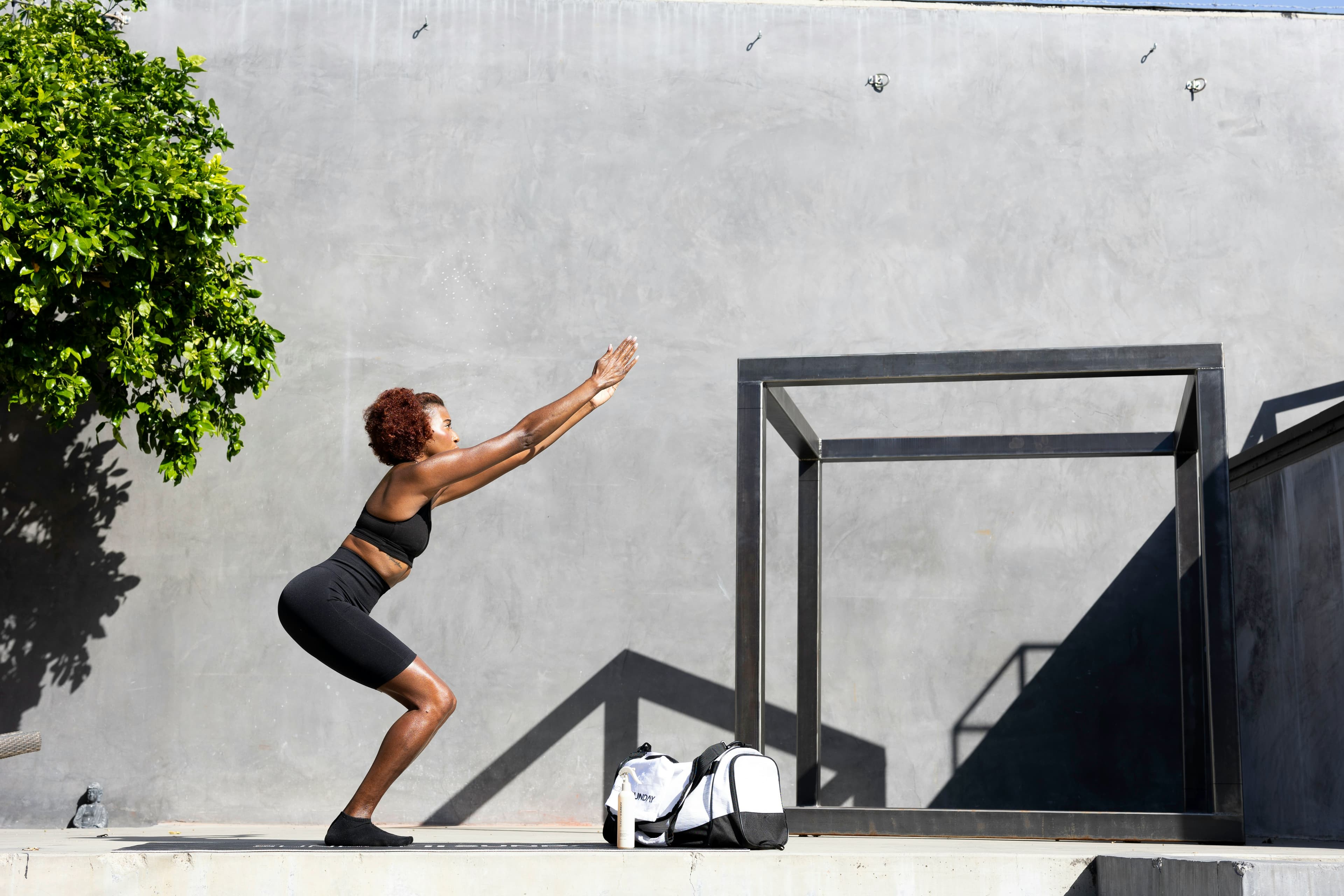
Pulse Squat Exercise: How to Do It, Benefits, and Muscles Worked
You've done squats before. But have you ever stopped at the bottom, moved just a couple of inches up, and held that burn for 30 seconds straight? That's a pulse squat — and the reason it feels so much harder than a regular squat isn't because you're working harder, it's because your muscles never get to rest.
That constant tension is the whole point. By staying in the bottom quarter of the squat and pulsing up and down just a few inches, your quads and glutes are forced to work non-stop from the first rep to the last. The result: more muscle fatigue, more strength gains, and a burn that makes full squats feel like a warm-up.
In this guide you'll learn exactly what a pulse squat is, how to do it with correct form, which muscles it targets, and how to add it to your training — whether you're a complete beginner or looking for a new way to push your lower body harder.
What Is a Pulse Squat Exercise?
A pulse squat is a squat variation that keeps you in the bottom quarter of the movement. Instead of standing back up at the top of each rep, you stop when your thighs hit parallel and pulse up and down just 2–3 inches, over and over, without ever fully straightening your legs.
This is what makes it different from a regular squat. In a full squat, your muscles briefly unload at the top of each rep as you stand up — that's a tiny moment of recovery built into every repetition. Pulse squats remove that recovery entirely. Your quads and glutes stay loaded from start to finish, which is why the burn sets in so fast and doesn't let up.
It's also different from a static squat hold. With a hold, your muscles are working isometrically — no movement at all. The pulse introduces a constant small motion that prevents the muscle from settling, keeping it firing continuously and making it significantly harder than holding still.
Pulse squats appear in Pilates, barre, HIIT circuits, and bodyweight training for good reason: they require no equipment, can be done anywhere, and deliver serious results in short sets. You can also load them with resistance bands, dumbbells, a kettlebell, or a barbell as you get stronger.
Important: The pulse is not a bounce. A bounce is fast and uncontrolled — it uses momentum to shift load away from your muscles and puts stress on your joints. A pulse is deliberate, smooth, and controlled. Think 2 seconds down, 2 seconds up. That's where the work happens.
How to Do a Pulse Squat (Step-by-Step)
Starting Position
- Stand with your feet shoulder-width apart, or slightly wider if that feels more comfortable
- Turn your toes out slightly — around 15 to 30 degrees
- Stand tall: chest up, shoulders back, core braced
- Distribute your weight evenly across your mid-foot and heels — not your toes
The Movement
- Hinge at the hips and bend both knees to lower into a squat
- Keep your chest tall and your knees tracking over your toes as you descend
- Lower until your thighs are parallel to the floor — or as low as your mobility allows without your lower back rounding
- From there, drive up just 2–3 inches — only slightly past the sticking point, not all the way up
- Lower back down with control to the bottom position
- Repeat in a smooth, continuous rhythm — no locking out the knees, no bouncing
Breathing
Keep your breathing steady throughout the set. Exhale as you pulse up, inhale as you lower back down. If you're holding your breath, you'll fatigue much faster and your form will break down sooner. Smooth, consistent breaths keep you in control.
How Many Reps and Sets
| Level | Sets | Reps / Time | Rest |
|---|---|---|---|
| Beginner | 3 | 15–20 reps or 30 seconds | 60 seconds |
| Intermediate | 4 | 25 reps or 45 seconds | 45 seconds |
| Advanced | 4–5 | 30+ reps or 60 seconds | 30 seconds |
Start on the lower end and add volume gradually. The goal is to maintain proper form throughout every rep of every set — not to hit a number and collapse.
Muscles Worked in Pulse Squats
Primary Muscles
Quadriceps — The quads are the main driver of the pulse squat. Specifically, the exercise targets the quads in the 60–90 degree knee flexion zone — the range where they're most stretched and most loaded. This is where the VMO (vastus medialis oblique), the teardrop-shaped muscle on the inner side of your knee, is most heavily activated. The VMO is often underdeveloped compared to the rest of the quad, and it's critical for knee tracking and stability. Pulse squats are one of the most effective exercises for building it.
Glutes (gluteus maximus) — At the bottom of the squat, the glutes are in their most lengthened position and under maximum load. Staying there — rather than standing up and releasing the tension — means the glutes stay engaged throughout every pulse.
Secondary Muscles
Hamstrings — The hamstrings assist with hip extension and help stabilise the knee joint during the movement. They're not the primary target, but they're working the whole time.
Calves (gastrocnemius and soleus) — Your calves anchor your ankle position and keep your heels grounded through each pulse. If your heels lift, your calves aren't doing their job — and your knees will pay for it.
Core (transverse abdominis, obliques, erector spinae) — Your core holds your torso upright and prevents you from collapsing forward. The deeper into a set you go, the more your core has to work to maintain position. This is especially true when you add load.
Why Pulse Squats Burn So Much (The Science)
If you've tried pulse squats and wondered why they hurt more than full squats even though you're barely moving — the answer comes down to two things: time under tension and the occlusion effect.
Time Under Tension (TUT)
In a regular squat, you get a brief moment of relief at the top of each rep as your legs straighten. That tiny break matters more than you'd think — it lets blood flow back into the muscle, flushes out metabolic waste, and gives your fibres a fraction of a second to recover.
Pulse squats eliminate that break entirely. Your muscles are under continuous load from the first rep to the last, which means fatigue accumulates faster, more muscle fibres are recruited to compensate, and the overall stimulus for growth is greater. Research consistently links longer time under tension to greater muscle hypertrophy — particularly in muscles like the VMO that are often undertrained through full ranges of motion.
The Occlusion Effect
Holding a low squat position under load also partially restricts blood flow to the working muscles — similar to the mechanism used in blood flow restriction (BFR) training. When oxygen delivery to the muscle drops, the body responds by recruiting fast-twitch muscle fibres earlier than it normally would. Fast-twitch fibres are the ones responsible for strength and size gains. Lactic acid accumulates quickly, which is why the burn arrives fast and compounds with every rep.
You don't need cuffs or bands to create this effect. The combination of a low position, constant muscle contraction, and continuous movement does it naturally. This is the same principle that Les Mills research points to when explaining why pulse movements produce such high levels of muscle fatigue in a short time.
What This Means for You
The burn isn't a sign that you're doing something wrong — it's evidence the exercise is working. Metabolic stress, muscle fibre recruitment, and time under tension are all key drivers of adaptation. Pulse squats create all three simultaneously, in a simple bodyweight movement that can be done anywhere.
Benefits of Pulse Squats
1. More Muscle Activation in Less Time
Because the pulse keeps your muscles loaded continuously, you get more total work done per set than with full squats. A 30-second set of pulse squats delivers sustained quad and glute activation that would take significantly more full squat reps to match.
2. VMO Development
The VMO is one of the hardest muscles to isolate and one of the most important for knee health. Pulse squats — held in the 60–90 degree knee flexion zone — are uniquely effective for targeting it. If you have a history of knee tracking issues or patellar pain, building the VMO is often part of the fix (with guidance from a physio).
3. Elevated Cardiovascular Demand
Staying in a low squat position under continuous tension keeps your heart rate elevated in a way that a standard set of squats doesn't. This makes pulse squats useful not just for strength but for conditioning — especially when used as a finisher or in a circuit.
4. Joint-Friendly
Counterintuitively, pulse squats are easier on the knees than deep full squats. The reduced range of motion means you avoid the high-compressive-force zone at the very bottom of a deep squat, while still getting significant quad and glute stimulus. For people with mild knee sensitivity, pulse squats can be a way to train the legs hard without aggravating their joints.
5. No Equipment Needed
The bodyweight version is fully effective and requires nothing but floor space. That makes pulse squats ideal for home workouts, hotel rooms, warm-ups before a gym session, or any situation where equipment isn't available.
6. Functional Carry-Over
The lengthened, loaded quad and glute position in a pulse squat is the same position your body uses when climbing stairs, sitting down and standing up, and descending from a step. Building strength and stability here has direct carry-over to everyday movement.
Common Mistakes to Avoid
| Mistake | Why It's a Problem | Fix |
|---|---|---|
| Bouncing instead of pulsing | Shifts load off muscles, risks knee strain | Aim for a 2-second up, 2-second down tempo — smooth and deliberate |
| Knees caving inward | Stresses the medial ligament and kneecap | Actively push knees out so they track over your little toes |
| Heels rising off the floor | Shifts load onto the knees and reduces glute activation | Drive your heels into the floor on every single pulse |
| Rounding the lower back | Compresses the lumbar spine | Brace your core before you descend and keep your chest up throughout |
| Pulsing too high | Removes the muscle from the target zone — less TUT, less benefit | Stay at or just below parallel; only move 2–3 inches, not a half squat |
| Holding your breath | Spikes blood pressure and accelerates fatigue | Exhale up, inhale down — keep breathing the whole way through |
Troubleshooting: Common Problems and How to Fix Them
"I keep falling forward." This usually comes down to ankle mobility or quad dominance. Try elevating your heels slightly on a plate or folded mat to reduce the ankle dorsiflexion demand. Widen your stance and turn your toes out more. Over time, work on ankle mobility stretches before your session.
"I feel it in my knees, not my quads." Check that your heels are firmly planted and your weight isn't shifting forward onto your toes. If your knees are tracking inward, push them outward actively. If knee discomfort persists rather than the normal quad burn, stop and assess your form before continuing.
"I lose balance mid-set." Fix your gaze on a point at eye level — looking down shifts your weight forward. You can also hold a wall or a door frame lightly until your balance improves. This is normal for beginners and resolves quickly.
Pulse Squat Variations and Progressions
Beginner
Wall-Supported Pulse Squat — Place your fingertips lightly on a wall, chair back, or door frame for balance. This lets you focus entirely on depth and controlled movement without worrying about falling. Remove the support once you feel confident.
Wide-Stance Pulse Squat — A wider stance reduces the ankle mobility and hip flexibility needed to reach depth. It also shifts emphasis slightly more toward the glutes and inner thighs. A good starting point if a shoulder-width stance feels restricted.
Intermediate
Banded Pulse Squat — Place a resistance band just above the knees. The band creates an inward pull that you have to resist by pushing your knees out, which dramatically increases glute and hip abductor activation throughout the set.
Goblet Pulse Squat — Hold a dumbbell or kettlebell at chest height, gripping it vertically. The counterbalance makes it easier to sit upright and reach depth, while adding load to increase the challenge on the quads and glutes.
Sumo Pulse Squat — Take a wide stance with toes turned out to 45 degrees. This variation shifts more emphasis onto the inner thighs (adductors) and glutes, and can feel more natural for those with wider hips.
Advanced
Barbell Pulse Squat — Either front rack or back rack. Requires a solid squat technique foundation — do not attempt this variation until your bodyweight and goblet pulse squats are consistent. The load dramatically increases the demand on every muscle involved.
Pulse Squat to Jump — Complete a set of pulses (e.g., 10 reps), then immediately explode upward into a jump squat. This trains both slow-twitch endurance and fast-twitch explosive power in the same set, and spikes heart rate fast.
Single-Leg Assisted Pulse Squat — Hold a support with one hand and perform pulse squats on a single leg. This is a stepping stone toward the pistol squat, and isolates one quad and glute entirely. Extremely challenging — expect far fewer reps than the bilateral version.
How to Add Pulse Squats to Your Workout
Pulse squats are versatile enough to serve several different roles depending on where you put them in a session.
As a Warm-Up
2 sets of 10 reps before squats, lunges, or any leg-dominant session. The goal isn't to pre-fatigue — use light, controlled pulses. This activates the VMO and glutes, warms the knee joint, and mentally prepares you for depth before you add load.
As a Finisher
3 sets of 30 seconds at the end of a leg session, when your muscles are already fatigued. This is where pulse squats shine — the accumulated fatigue from your main work means even bodyweight pulses create significant metabolic stress and muscle pump.
In a HIIT Circuit
40 seconds on, 20 seconds off, cycling between pulse squats and upper body movements. Because pulse squats are lower-body focused, they allow your upper body to recover between rounds while keeping heart rate elevated.
Sample Leg Day Placement
- Warm-up: 2 × 10 bodyweight pulse squats
- Main work: Back squats 4 × 5, Romanian deadlifts 3 × 8, leg press 3 × 12
- Finisher: 3 × 30-second goblet pulse squats with 30 seconds rest between sets
Pulse Squats vs. Regular Squats — Which Is Better?
This is the question that comes up most often, and the honest answer is: they're not competing with each other.
| Factor | Pulse Squat | Full Squat |
|---|---|---|
| Range of motion | Partial (bottom quarter) | Full |
| Time under tension | High | Moderate |
| Strength gains | Good — hypertrophy and endurance | Better — maximum strength |
| Cardiovascular demand | Higher | Lower |
| Equipment needed | None required | Optional |
| Knee stress | Lower | Higher at range extremes |
| Best for | Quad isolation, VMO, conditioning, home training | Overall lower body strength and power |
Regular squats move through a full range of motion, build more total strength, and train the body to produce force from different positions. They're the foundation of lower body training. Pulse squats add a specific stimulus — sustained tension, VMO targeting, metabolic stress — that full squats don't provide in the same way.
The best approach is to use both. Full squats for strength, pulse squats for time under tension, conditioning, and targeting the quad muscles that full squats under-recruit.
Conclusion
Pulse squats are one of the most underrated leg exercises you can do — especially if you're training without equipment or looking to add more intensity to the end of a leg session. The movement is simple, the setup is zero, and the results are disproportionate to how small the range of motion looks from the outside.
The science is straightforward: staying in the bottom position under constant tension removes the recovery that full squats provide, forces more muscle fibre recruitment, and mimics the blood flow restriction effect that makes muscles grow and strengthen faster. Your VMO gets trained in exactly the position it struggles most. Your heart rate climbs. The burn accumulates fast.
Start with bodyweight. Get the form right — controlled pulses, heels planted, chest tall. Once three sets of 20 reps feel manageable, add a resistance band or a goblet hold and work from there.
Try adding pulse squats as a finisher to your next leg session. Three sets of 30 seconds, 30 seconds rest between each. See how you feel the next day. If you want a full structure to plug them into, use this free home workout plan without equipment. If your goal is broader core strength alongside legs, pair this with our abs workout at the gym guide.
FAQ
A pulse squat is a squat variation where you hold the bottom position and move up and down in a small range of motion (a few inches). This keeps your muscles under constant tension without ever fully standing up.
Pulse squats primarily target the quadriceps (especially the VMO), glutes, and hamstrings. Your calves and core also work to stabilise the movement.
They serve different purposes. Pulse squats excel at time under tension and quad isolation, making them a great complement to full squats. Regular squats build more overall strength through a full range of motion.
When done with proper form, pulse squats are actually easier on the knees than full squats. The limited range of motion reduces compressive force. Keep your weight in your heels and avoid letting your knees cave inward.
Start with 3 sets of 15–20 reps or timed sets of 30 seconds on, 30 seconds off. Prioritise controlled movement over rep count.
Yes — pulse squats are beginner-friendly. Start with a wider stance and slow, controlled pulses. You can hold a wall or chair for balance while learning the movement.
A regular squat moves through a full range of motion — down and all the way back up. A pulse squat stays in the bottom quarter of that range, keeping the muscles loaded the entire time.
Progress from bodyweight to resistance bands, then to goblet pulse squats with a dumbbell or kettlebell, and eventually barbell pulse squats for maximum load.