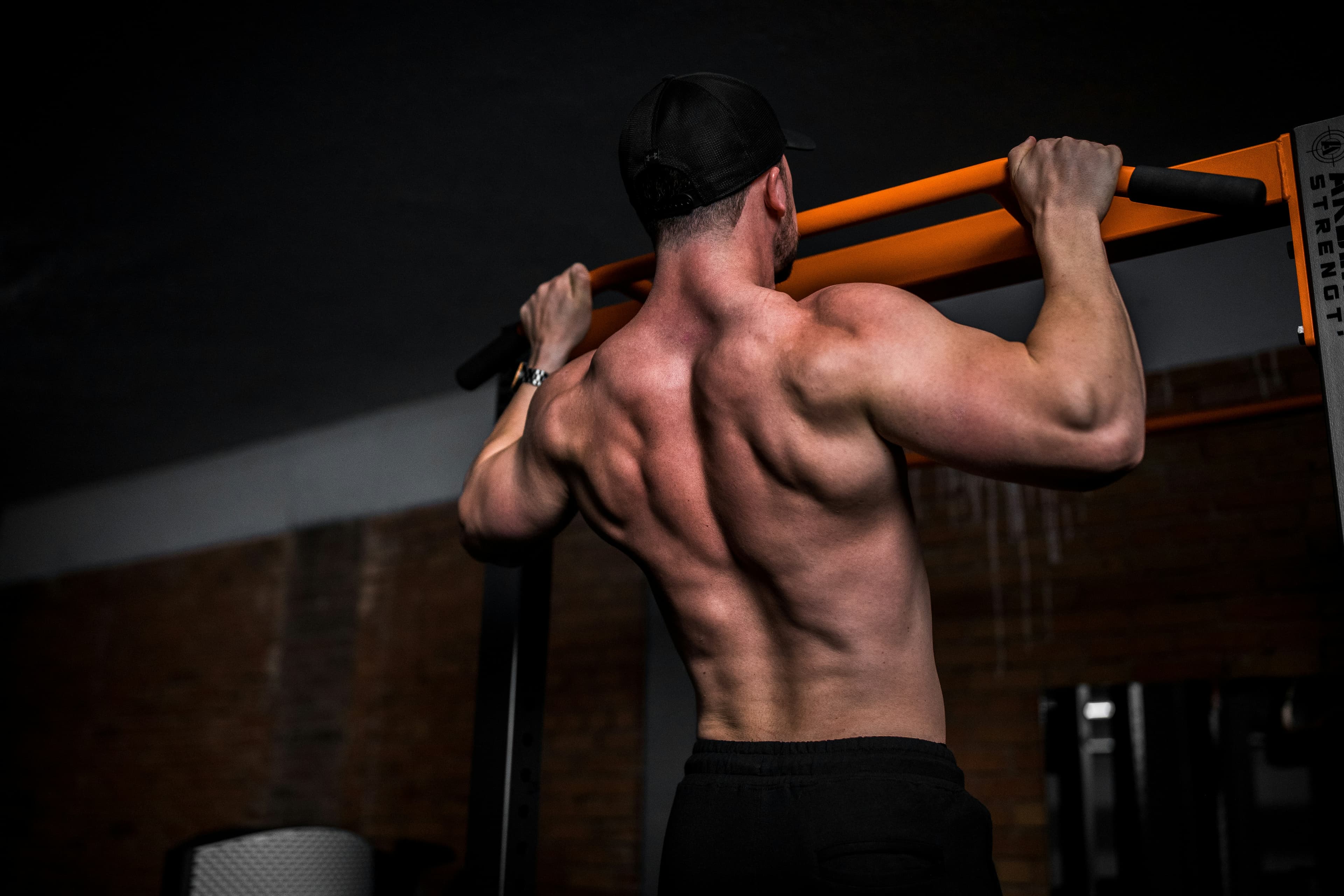
Pull-Up Strength Standards: How Many Should You Be Able to Do?
Pull-ups are one of the most honest tests of upper body strength. There's no adjusting the weight, no machine to stabilise you — just you, the bar, and gravity. That's exactly why so many people are curious about where they stand.
Whether you're working toward your first unassisted rep, trying to figure out if 10 pull-ups is actually impressive, or comparing yourself to military benchmarks, this guide gives you the full picture.
What Pull-Ups Actually Test
Before diving into numbers, it's worth understanding what pull-ups measure. They're a relative strength exercise — your ability to move your own body through space. This is why heavier lifters often find pull-ups harder than lighter athletes with comparable gym strength. A 250 lb man doing 8 clean reps is moving significantly more total load than a 160 lb man doing the same number.
The primary muscles involved are:
- Latissimus dorsi (the "lats") — the large back muscles that do most of the pulling
- Biceps brachii — assist heavily through the elbow bend
- Rear deltoids and rhomboids — stabilise the shoulder throughout the rep
- Core — keeps your body from swinging and transfers force efficiently
Weakness in any one of these creates a ceiling on your rep count, even if the others are strong.
Pull-Up Strength Standards by Experience Level
These benchmarks apply to strict, dead-hang pull-ups with full range of motion — starting from a dead hang with arms fully extended, pulling until your chin clears the bar, then returning to a full hang before the next rep. Kipping, partial reps, and momentum don't count here.
Men
| Level | Reps (Bodyweight) | Description |
|---|---|---|
| Untrained | 0–1 | No consistent training history |
| Beginner | 1–4 | 0–6 months of regular training |
| Novice | 4–8 | 6–12 months of consistent training |
| Intermediate | 8–12 | 1–2 years of structured training |
| Advanced | 12–17 | 2–5 years of serious training |
| Elite | 17–20+ | Competitive athletes and dedicated calisthenics practitioners |
Women
| Level | Reps (Bodyweight) | Description |
|---|---|---|
| Untrained | 0 | No consistent training history |
| Beginner | 1–2 | 0–6 months of regular training |
| Novice | 2–4 | 6–12 months of consistent training |
| Intermediate | 4–7 | 1–2 years of structured training |
| Advanced | 8–12 | 2–5 years of serious training |
| Elite | 12+ | Competitive athletes and dedicated calisthenics practitioners |
The gap between men and women reflects a physiological reality: men carry roughly 97% more upper body muscle mass on average. This doesn't mean women can't achieve impressive pull-up numbers — it just means the benchmarks need to be gender-specific to be useful.
Pull-Up Standards by Age
Pull-up ability tends to peak in the mid-20s to early 40s, when muscle mass, recovery capacity, and training experience typically converge at their highest combined point. After 40, sarcopenia (age-related muscle loss) begins to accelerate, but the effect is manageable with consistent strength training.
Average Reps by Age — Men (Intermediate Fitness Level)
| Age Range | Good | Strong | Elite |
|---|---|---|---|
| 18–29 | 8–10 | 13–15 | 20+ |
| 30–39 | 7–9 | 12–14 | 18+ |
| 40–49 | 5–7 | 10–12 | 15+ |
| 50–59 | 4–6 | 8–10 | 12+ |
| 60+ | 2–4 | 6–8 | 10+ |
Average Reps by Age — Women (Intermediate Fitness Level)
| Age Range | Good | Strong | Elite |
|---|---|---|---|
| 18–29 | 3–5 | 7–9 | 12+ |
| 30–39 | 2–4 | 6–8 | 10+ |
| 40–49 | 1–3 | 4–6 | 8+ |
| 50–59 | 1–2 | 3–5 | 6+ |
| 60+ | 0–1 | 2–4 | 5+ |
The key insight here: declining with age is normal, but a sharp decline is usually a training issue, not an inevitable biological outcome. Athletes who train consistently through their 40s and 50s often outperform sedentary 25-year-olds.
How Bodyweight Affects the Standards
Pull-ups get harder as your bodyweight increases, which makes direct rep-count comparisons between athletes of different sizes misleading. A few context-setting examples:
- A 150 lb man doing 12 pull-ups and a 210 lb man doing 12 pull-ups are not performing the same feat. The heavier man is moving significantly more total load.
- A 130 lb woman doing 8 pull-ups is performing at elite relative strength, even though 8 is a number many male gym-goers would find easy.
This is why weighted pull-up standards (see below) are a more accurate measure of raw strength once you're past the beginner stage.
Weighted Pull-Up Standards
Once you can comfortably perform 10+ bodyweight pull-ups, weighted pull-ups become a better benchmark. These are done with a dip belt, weight vest, or dumbbell held between the legs.
Men — Added Load for 1 Rep Max
| Level | Added Load |
|---|---|
| Beginner | Bodyweight only |
| Intermediate | +25–50% of bodyweight |
| Advanced | +50–80% of bodyweight |
| Elite | +80–100%+ of bodyweight |
Women — Added Load for 1 Rep Max
| Level | Added Load |
|---|---|
| Beginner | Bodyweight only |
| Intermediate | +10–25% of bodyweight |
| Advanced | +25–50% of bodyweight |
| Elite | +50–75%+ of bodyweight |
To put the elite standard in perspective: an elite 180 lb man could perform a single weighted pull-up with 144+ lbs hanging from him — totalling over 320 lbs of load moved through a full range of motion. That's serious strength by any measure.
Military Pull-Up Standards
Military fitness tests offer a useful external benchmark, particularly for functional strength.
US Marine Corps
The Marine Corps Physical Fitness Test (PFT) uses pull-ups as one of its primary events, and it's the most demanding pull-up standard in the US military:
- Minimum to pass the Initial Strength Test (IST): 2 pull-ups
- Perfect score on the PFT: 23 pull-ups (men)
- Pull-ups can be performed overhand or underhand (chin-up grip)
- The rep begins from a dead hang and requires the chin to clear the bar
Critically, Marines who choose pull-ups can score a maximum of 100 points for the event. Those who choose push-ups instead max out at 70 points — making pull-ups the higher-value choice for those who can do them.
US Army
The Army Combat Fitness Test (ACFT) does not use pull-ups as a standard event. It uses push-ups, sit-ups, and a 2-mile run. This is worth knowing if you're using Army benchmarks — you won't find pull-up standards in their official test.
Navy SEALS
SEAL candidates use pull-ups in their Physical Screening Test. The standard for candidates is:
- Minimum: 8 pull-ups (with no time limit)
- Competitive score: 15–20+ pull-ups
SEAL training is a useful reference point for what "functionally elite" looks like — 15+ pull-ups at a competitive level, on top of elite swimming, running, and pushing capacity.
Why You Might Be Stuck Below Your Target Standard
Research and coaching experience consistently point to the same handful of reasons why trained people plateau on pull-ups:
1. You're not practising pull-ups specifically
Lat pulldowns, rows, and curls build the muscles involved — but pull-ups are a skill as much as a strength exercise. Your neuromuscular system needs to learn how to coordinate the movement pattern. If you're not doing pull-ups (or close variations like negatives and hangs), you won't improve at pull-ups.
2. Grip strength is your real limiting factor
Most people hit grip failure before lat failure. If your hands give out before your back, your pull-up count will never reflect your actual pulling strength. Dead hangs and farmer carries fix this directly.
3. Your core is leaking energy
Pull-ups require a rigid, braced torso to transfer force efficiently. If your lower body swings or your ribcage flares, you lose a significant portion of the power your lats generate. Add plank variations and hollow body holds to your routine.
4. You're not using full range of motion
Starting from a bent-arm position and stopping short of full chin-over-bar counts neither as a clean rep nor as productive training. Full dead-hang reps train a much larger portion of the strength curve and build more durable strength.
5. Shoulder mobility is blocking the bottom position
Tight shoulders and lats prevent full overhead extension, which means every rep starts from a compromised position. If your elbows are slightly bent at the bottom of your hang, shoulder mobility work is essential.
6. You're too heavy relative to your strength
This isn't about aesthetics — it's physics. If you've gained significant body weight without proportionally increasing pull-up strength, your rep count will drop. This is one reason why many people find pull-ups harder after a bulk.
Progression Benchmarks: What to Aim for Next
If you want a clear roadmap, here's how to think about your next milestone:
Can't do a single rep yet: Focus on dead hangs (30+ seconds), negative pull-ups (slow lower from the top), and band-assisted pull-ups. Most beginners reach their first unassisted rep in 4–12 weeks.
1–3 reps: Practice sets of 1–2 reps multiple times throughout the day (greasing the groove). Add 1 rep every 1–2 weeks. You'll hit 5 reps faster than you expect.
5–8 reps: Move to structured sets. Three sets of submaximal reps (leaving 2–3 reps in reserve) 2–3 times a week builds this range effectively. 10 reps is within reach in a few months.
10–12 reps: Introduce weighted pull-ups with light load (+5–10 kg) for lower rep sets. This builds the strength base to push bodyweight reps higher. This is where most dedicated gym-goers sit.
12–15 reps: You're advanced. Weighted progressions, ring pull-ups, and archer pull-ups are appropriate next challenges. Hitting 20+ bodyweight reps or adding significant load are your elite-level targets.
What "Good" Actually Means
The benchmarks above are useful reference points, but "good" is ultimately relative to your goals. A calisthenics athlete building toward a muscle-up needs a different rep standard than someone who wants enough functional upper-body strength to stay healthy for decades.
A practical general target for most people: 10 strict pull-ups for men, 5 for women. This level of performance reflects genuine functional upper body strength, places you solidly in the intermediate category, and is achievable for most people with 1–2 years of consistent training.
If you're at that level and wondering what's next, the answer is usually weighted pull-ups — because adding reps indefinitely is less useful than building raw strength.
The pull-up is one of those rare exercises that tells you something real about your fitness. Use the standards above as orientation, not judgement — and focus on where you are now versus where you were three months ago. If you are building from zero, follow this first pull-up progression guide. If you still need foundational strength first, start with calisthenics for beginners.
FAQ
For men new to training, 1–3 clean, dead-hang pull-ups is a reasonable starting point. Getting to 5 reps with full range of motion marks a real milestone worth celebrating.
The average untrained man can do 0–1 pull-ups. Men who train regularly average around 6 reps. After two consistent years of training, most men reach 10–12 reps.
The average woman can do 1–3 pull-ups. Women who train regularly for two or more years typically reach 5–6 reps. Hitting 8+ puts you in the advanced category.
Marines must do at least 2 pull-ups to pass the Initial Strength Test. The maximum score on the Physical Fitness Test requires 23 pull-ups for men. Women have different minimum thresholds.
Yes, significantly. Pull-ups are a relative strength exercise — the more you weigh, the harder every rep becomes. A 220 lb man doing 10 reps is demonstrating more raw strength than a 150 lb man doing the same, even though the rep count looks equal.
Most people can reach the intermediate threshold (8+ reps for men, 3+ for women) within 6–18 months of consistent, progressive training. Beginners who can't do a single rep typically achieve their first unassisted pull-up within 4–12 weeks.
For men, 20+ strict pull-ups in one set is elite. For women, 12+ is elite. In weighted terms, elite means pulling with an additional load of roughly 80% of your bodyweight for a single rep.
Pull-ups test relative strength — your ability to move your own bodyweight. You might be strong in absolute terms but carry extra mass that makes bodyweight moves harder. Grip weakness, poor lat activation, and lack of practice on the specific movement pattern are also common culprits.